
Boundaries: What They Are and How to Keep Them

Have you ever said yes when every part of you wanted to say no? Or walked away from a conversation feeling drained, resentful, or quietly frustrated with yourself? If so, you are not alone. Many of the people I work with describe this exact feeling, and very often, the missing piece is boundaries.
Boundaries are one of the most practical tools we have for protecting our mental health. They are also one of the most misunderstood. Let's talk about what they are, why they matter, and how to hold onto them, even when someone keeps pushing.
What Are Boundaries?
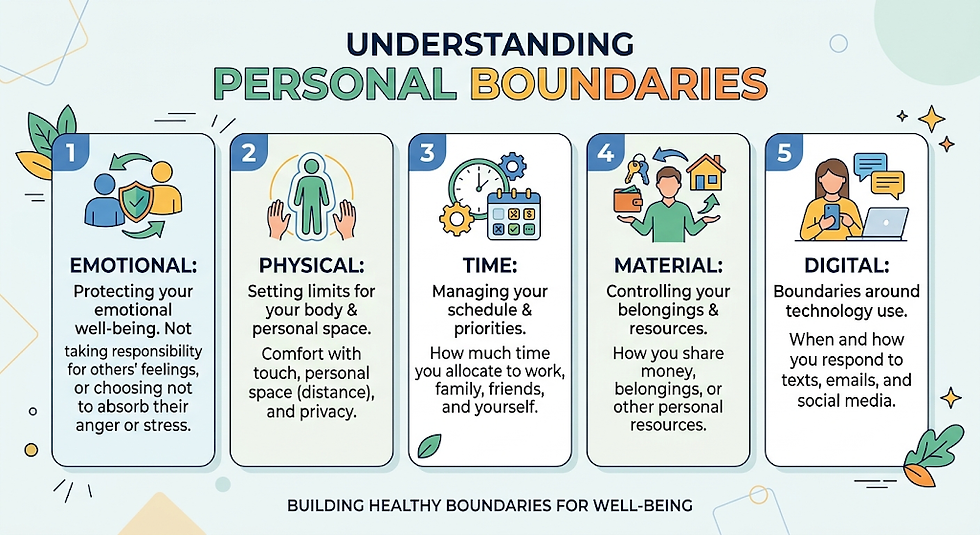
A boundary is a limit you set to protect your time, energy, body, emotions, and values. It is a clear statement of what you will and will not accept, and what you will do if that limit is crossed.
Boundaries come in several forms:
Emotional: not taking responsibility for other people's feelings, or choosing not to absorb someone else's anger or stress
Physical: your comfort with touch, personal space, and privacy
Time: how much of your schedule you give to work, family, friends, and yourself
Material: how you share money, belongings, or resources
Digital: when and how you respond to texts, emails, and social media
It helps to know what boundaries are not. A boundary is not a punishment, an ultimatum, or an attempt to control someone else. "You can't talk to me that way" is a request about another person's behavior. "If you raise your voice, I'm going to end the conversation" is a boundary, because it describes what you will do. Boundaries are about your actions, not theirs.
Why Boundaries Matter
Without boundaries, we tend to run on empty. Over time, chronically overriding our own needs can feed into stress, irritability, poor sleep, burnout, and resentment in our closest relationships. It can also make anxiety and low mood harder to manage.
Healthy boundaries help you:
Protect your energy so you have more to give to the people and things that matter most
Reduce resentment, which often builds quietly when we keep saying yes out of guilt or obligation
Build trust in your relationships, because people know where they stand with you
Strengthen self-respect by showing yourself that your needs count, too
Support your treatment goals, whether you are working on anxiety, depression, or recovering from a difficult season of life
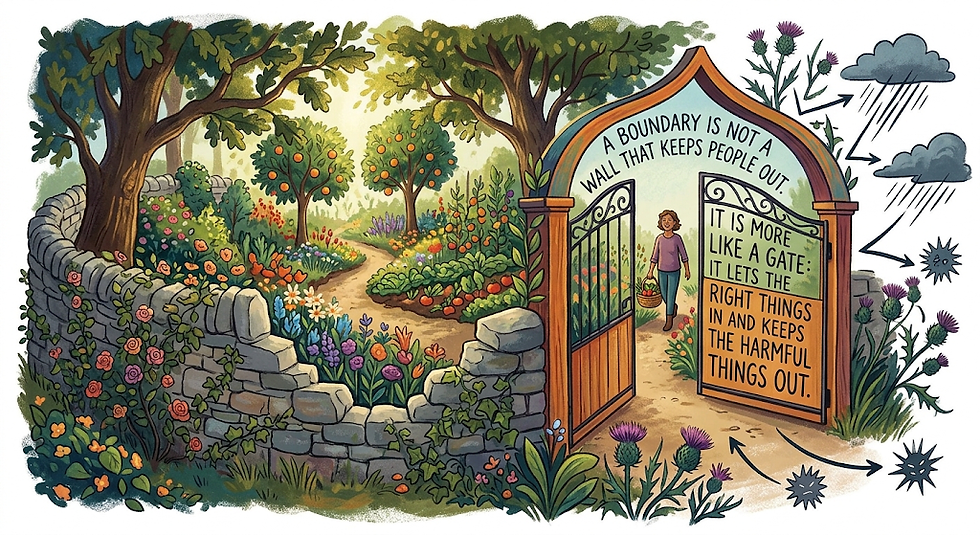
A boundary is not a wall that keeps people out. It is more like a gate: it lets the right things in and keeps the harmful things out.
How to Set and Maintain Boundaries
Setting a boundary is the first step. Keeping it is where the real work happens. A few strategies that help:
Get clear on your limits first. Pay attention to moments when you feel drained, anxious, or resentful. Those feelings are often signals that a limit has been crossed.
Keep it simple and direct. You do not owe a long explanation. "I'm not able to take that on right now" is a complete sentence. So is "No thanks".
Use "I" statements. "I need some quiet time after work before we talk about plans" lands more gently than "You always bombard me."
Be consistent. A boundary enforced only some of the time teaches people that it is negotiable. Follow through, even when it feels uncomfortable.
Expect some discomfort. Guilt is common when you first start setting limits, especially if you are used to being the helper. Feeling guilty does not mean you did something wrong. It often means you are doing something new.
Start small. Practice with lower-stakes situations, like declining an extra commitment, before tackling harder conversations.
Take care of yourself afterward. Holding a boundary can be emotionally tiring. Rest, journal, or talk it through with someone you trust.
Remember that people who benefited from you having no boundaries may push back at first. That reaction is not proof the boundary is wrong.
When Someone Keeps Crossing the Line
Some people will test a boundary once and adjust. Others will push again and again. When a boundary is repeatedly ignored, it is time to shift from stating the boundary to enforcing it.
Restate it once, clearly and calmly. "I've told you I won't discuss my weight. If it comes up again, I'll leave."
Follow through with the consequence you named. Hang up the phone. Leave the gathering. Stop replying to late-night messages. Consistency is what gives a boundary meaning.
Stop over-explaining. Repeated justification invites debate. You can simply say, "I've already answered that."
Adjust the level of access. You get to decide how much time, information, and closeness someone receives. Seeing a person less often, keeping conversations surface-level, or limiting contact to group settings are all valid choices.
Document when needed. In work or legal situations, keep a written record of repeated violations.
Consider distance or ending the relationship. If someone consistently disregards your limits despite clear communication, that tells you something important about how they value your well-being.
If boundary violations involve threats, intimidation, or physical harm, your safety comes first. Call 911 in an emergency, or reach the National Domestic Violence Hotline at 1-800-799-7233. If you are in emotional crisis, call or text 988.
A Word About Toxic People
"Toxic" gets used a lot these days, and not every difficult person fits the label. Everyone has bad days. What sets a toxic pattern apart is consistency: behavior that repeatedly leaves you feeling smaller, confused, or unsafe.
Common signs include:
Guilt-tripping or manipulation when you say no
Dismissing or mocking your feelings
Twisting events so you start to doubt your own memory
Taking without giving, with the relationship always revolving around their needs
Treating your boundaries as a challenge to overcome
With people like this, the goal is not to get them to understand or agree with your boundary. They may never do either. The goal is to protect yourself. Keep responses brief and neutral, avoid emotional debates, and give yourself permission to step back. Choosing distance from a toxic person, even a family member, is not cruelty. It is self-preservation.
You Deserve Relationships That Respect You
Learning to set and hold boundaries is a skill, and like any skill, it gets easier with practice. Be patient with yourself as you learn. Every time you honor a limit, you are reinforcing the message that your well-being matters.
If you find that anxiety, depression, past experiences, or ongoing stress are making it hard to protect your peace, you do not have to figure it out alone. At Windrise Psychiatry and Wellness, I offer telehealth psychiatric care for adults in Arizona and Montana. Reach out to schedule an appointment and take the next step toward feeling more like yourself.
This post is for educational purposes only and is not a substitute for individualized medical or mental health care.


Comments